



A solution for workshop camera systems in Hung Yen consists of multiple components working together: cameras, transmission links, power supplies, recording devices and playback tools. If individual cameras are selected without considering these connections, a business may have working live views but incomplete recordings or limited expansion options.
The plan should therefore show the path of images from observation points to storage and users. A clear diagram also helps isolate faults after handover.

Build the diagram around working areas
Begin with the workshop floor plan, entrances, production areas, packing areas and storage. Each camera needs an identifier, an observation task and a planned connection point. Survey cable routes together with obstacles, distances and actual installation conditions.
For sites with several zones, consider local network cabinets to aggregate connections before sending them to the central location. Choose the topology based on distances, maintainability and traffic, not merely a convenient place to hang a cabinet.
Check networking and power against the configuration
Check PoE power delivery
When using PoE, check the camera's supported standard, each port's power capacity and the switch's total power budget. Consumption may differ between normal operation and operation with additional functions enabled. Do not count spare ports alone to conclude that a switch has enough expansion capacity.
Calculate branch-to-core transmission requirements
Compare each branch's total camera traffic with uplink capacity, recording equipment and simultaneous viewing requirements. For long routes or environments with specific requirements, choose copper or fiber according to a suitable design and equipment specifications.
When organizing workshop camera systems in Hung Yen, coordinate with IT on traffic separation and access management. The camera-network diagram should accurately reflect the infrastructure in use, avoiding discrepancies between actual configurations and handover documents.
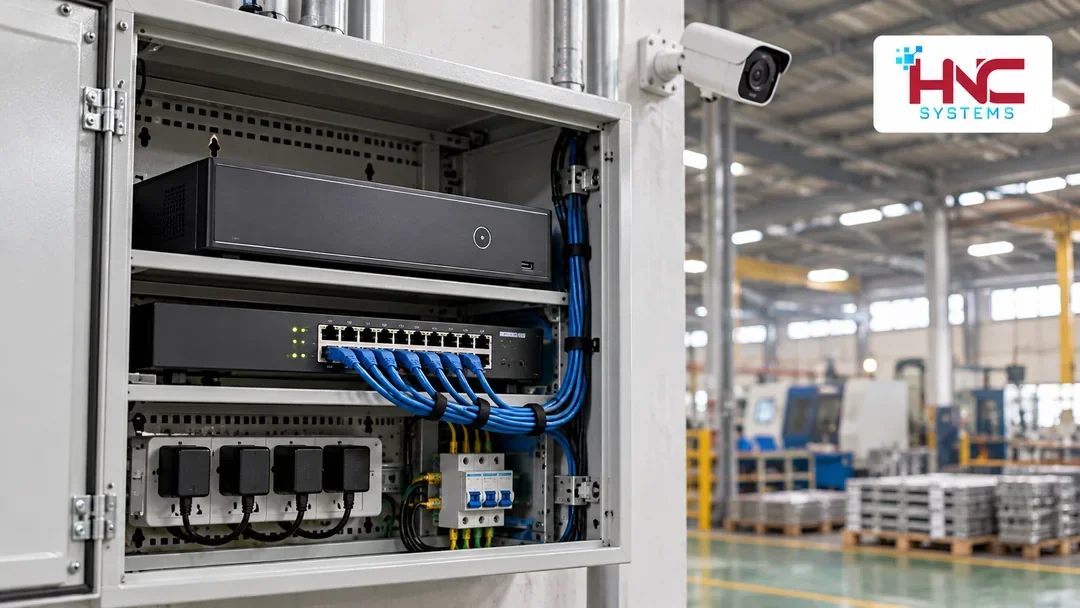
Select recording equipment for the complete workload
Check recording equipment for channel count, incoming bandwidth, playback capabilities and supported storage capacity. A recorder with spare channels may still be unable to handle additional higher-quality streams or many simultaneous users.
Retention time depends on camera count, recording schedules, quality settings and scene characteristics. Calculate it from the planned configuration, then verify it during operation. For event-based recording, test trigger scenarios and the required footage before and after events.
Prepare for component failures
Within supported capabilities, the system should detect disconnected cameras, storage faults and incorrect device time. Whoever receives notifications should know which component to check first and whom to contact, rather than simply ignoring a black camera tile.
- Record the switch and cable route associated with each camera.
- Identify related power supplies and storage devices.
- Agree on checks to perform when power returns after an outage.
- If backup power is used, identify which devices it supplies and the runtime to be tested.
Backup power for a recorder does not automatically keep all cameras working if their PoE switches have lost power. The backup scope must cover the appropriate chain of devices supporting the chosen task.
Test the entire image workflow at acceptance
For each priority area, check live viewing, recordings, searching and video export. Test with a viewer count representative of operational needs, not just one computer while the system is lightly loaded.
Check accounts against their intended roles: viewers must not inadvertently have configuration-editing rights, and users responsible for exports must be able to perform those tasks. Also compare camera names, displayed times and equipment identifiers with the documentation.

Provide a realistic basis for expansion
Plans for additional production areas should be translated into estimated camera-point counts, traffic, power and storage requirements. Deployment can be phased, but the limits of each component should be understood from the start. Retain older equipment only after checking image quality, condition and compatibility.
To discuss workshop camera systems in Hung Yen with HNC Systems, prepare the floor plan and existing equipment list. These provide a basis for clarifying what can be reused, what must be added and which tests are needed before handover.
HNC Systems · Hotline: 0918.899.229.