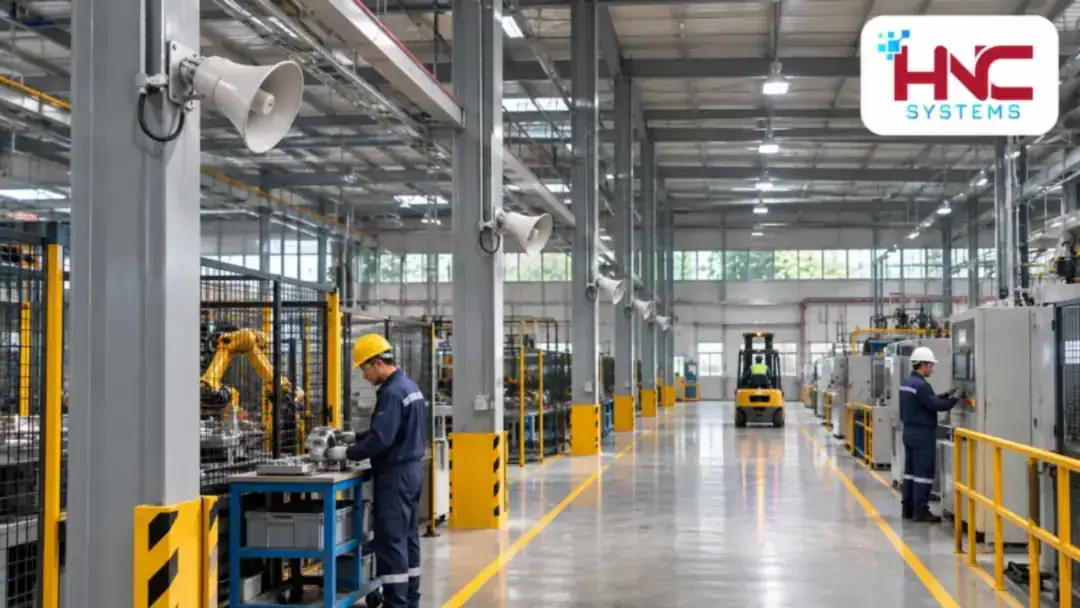


A transmitted announcement is not necessarily an understood announcement. For factory public address system installation in Ninh Binh, first identify who needs the information, where they work and how machinery operates around them. The objective should be that listeners understand the required action, rather than merely confirming that a loudspeaker produces sound or raising the volume across the entire site.
Start With The Message And Its Audience
List actual uses: calling maintenance, announcing shift changes, coordinating deliveries or sharing work schedules. For each use, identify authorized operators, the required listening zone and when it will be used. An announcement for one production team does not automatically need to reach offices, stores and break areas.
Separate routine operational announcements from emergency warnings or evacuation guidance. A general public address system does not automatically qualify as a life-safety voice alarm system. If that function is required, obtain specialist design, verify applicable standards and coordinate with those responsible for related systems.

Survey Noise Under Representative Conditions
Assess listening positions at ear height with machinery running in its usual modes. Record high-noise locations, long reverberation, barriers and distant points. Empty workshops, stopped lines and fully stocked warehouses may sound different; a quiet-period test alone cannot establish performance.
Loudspeaker power is not the only measure. Speech clarity also depends on aiming, distance, reflections and background noise. Where hearing protection is mandatory, assess performance with the safety team. Do not ask workers to remove protection just for the test or increase levels indiscriminately.
Define Zones Around Work And The Floor Plan
Use the intended audience to define zones such as production lines, dispatch stores, loading yards and corridors. Check adjoining zones too: overlapping announcements with different delays can confuse listeners at the boundary. Adjust direction, placement and levels after the survey rather than applying equal speaker spacing mechanically.
For factory public address system installation in Ninh Binh, agree on a clear zone-selection panel at the paging desk. Zone names should match the drawing and actual use. If several sources can broadcast, document priorities, interruption permissions and safeguards against selecting the wrong area. Verify them with simulated scenarios before handover.
Match Equipment And Cabling As A System
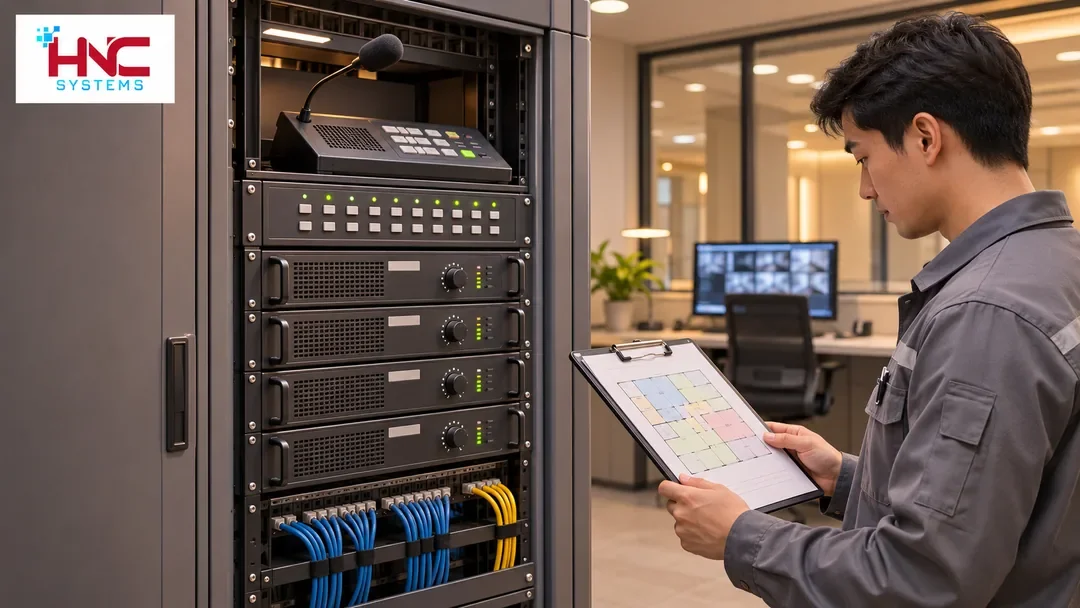
Select loudspeakers for the environment and listening task. Indoor locations, dusty or damp areas and outdoor positions require suitable protection. Equipment ratings and installation instructions must suit the actual position; an office speaker is not automatically suitable throughout a factory.
Check total speaker load, connections and amplifier capability against the design, including agreed headroom. Competent personnel should handle cable routes, mechanical protection, electrical supply, earthing and rack cooling. Label each circuit so a silent zone can be isolated without retracing the whole installation.
Test Speech And Real Operating Scenarios
Prepare short, clear messages similar to those used in daily work. Test listeners at representative positions should repeat the information they heard rather than simply acknowledge that there was sound. Record location, machinery conditions, active zone and defects. If an intelligibility measurement is required, agree the method and acceptance threshold before installation.
Test individual and combined zones, source changes and agreed priority scenarios. Check levels in quiet areas and at zone boundaries; correct weak, excessive or feedback-prone positions. Test emergency functions only within an approved scope and coordinated safety procedure. Do not activate an alarm independently and disrupt production.

Hand Over A System Every Shift Can Operate
The handover should include zone drawings, equipment lists, circuit labels, agreed settings, zone-selection instructions and authorized operators. Let shift staff practise an announcement, stopping it and basic checks when there is no sound. Define who receives faults and when they must escalate to a technician.
Set a maintenance schedule appropriate to use and review coverage after machinery, partitions or room functions change. Retain test results and configuration changes. If standby power or fault monitoring is contracted, document its checks and limitations rather than assuming those features are included.
Prepare The Information Needed For A Proposal
Businesses in Ninh Binh can prepare a floor plan, required zones, shift patterns, existing equipment and current problems. Ask for a quote separating equipment, cable routes, installation, configuration, testing and operator training. Record exclusions, permitted work windows and warranty conditions.
HNC Systems can discuss survey requirements for a public address proposal based on the existing site. Agree scope, acceptance criteria and implementation timing once sufficient information is available instead of assuming one configuration or fixed price suits every factory.
HNC Systems · Hotline: 0918.899.229.