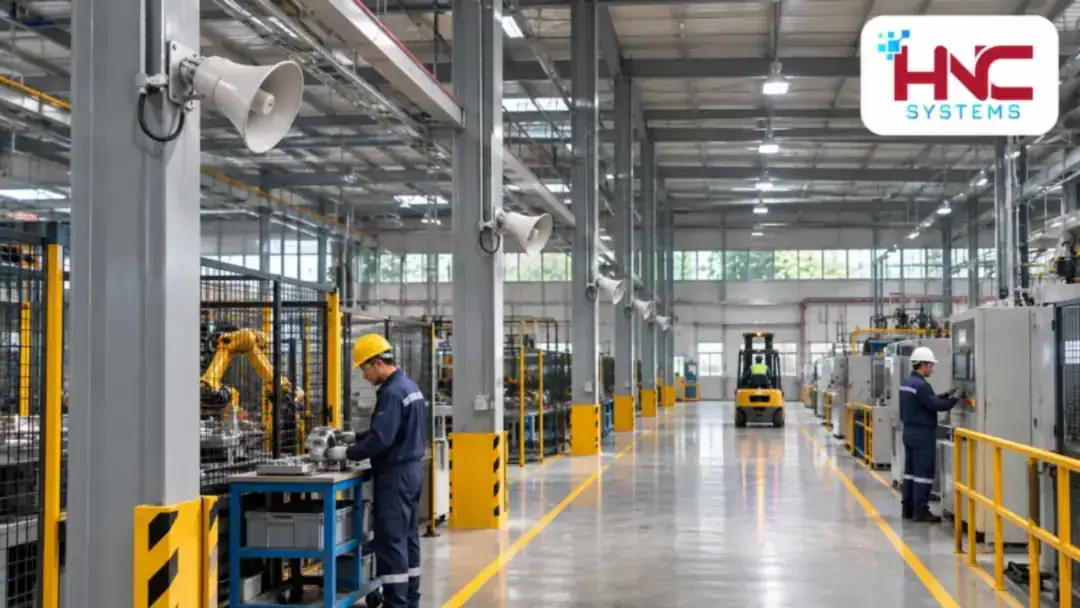



Factories contain many factors that change wireless signals: machinery, metal racks, stored goods and movement routes. A solution for Wi-Fi for factories in Hung Yen should begin with where devices actually work, rather than calculating the number of access points from floor area alone.
Handheld scanners, tablets and vehicle-mounted devices may have different requirements. Identify critical tasks, areas requiring connectivity and the level of interruption the process can tolerate.
Survey obstacles under operating conditions
Storage racks and metal structures
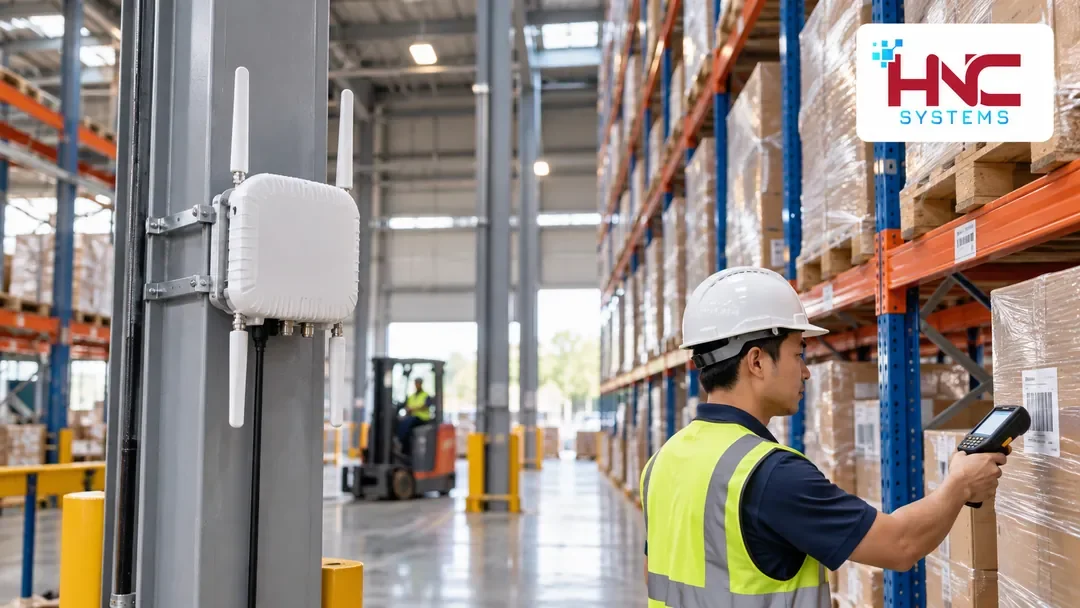
Metal can block or reflect radio signals, making coverage uneven. An aisle that looks clear may still have poor connectivity behind the racks. Survey individual rows and working positions, especially where the height or density of goods changes.
Machinery and production-line layout
Machine enclosures, partitions and large equipment create areas that need separate checks. Coordinate AP positions with site operations and safety requirements so they do not obstruct walkways, machinery maintenance or vehicle routes.
A survey conducted in an empty factory represents only one reference condition. If stock levels change frequently, record the survey conditions and plan to retest under conditions representative of busy production or high storage levels.
Design for the handheld devices actually in use
A technician's phone may connect well while an operational scanner still encounters errors. Collect the actual devices' models, software versions, supported bands and authentication methods. Test compatibility before rolling out network configuration upgrades widely.
When building Wi-Fi for factories in Hung Yen, test tasks end to end: scanning a barcode, sending data and receiving a response from the application. A signal icon does not prove that the business transaction has completed.

Choose positions and antennas to match the area
A high ceiling does not mean the AP should be mounted at the highest point. Assess height, antenna direction and obstacles together so signals reach the intended working area. Directional antennas may suit some aisles, but they must be selected and tested for the specific design.
Increasing power only at the AP may not improve the return transmission from a handheld device. Assess two-way connection quality and channel planning rather than relying entirely on the assumption that a more powerful transmitter provides better coverage.
Test roaming along actual movement routes
Stock-checking staff may walk through several rows, while vehicle-mounted devices follow different routes. Test transitions between APs while the application is active, at speeds and in operating positions that match real procedures.
- Check aisle ends, inter-zone doors and loading or receiving points.
- Approach frequent disconnection locations from several directions.
- Record the time, position and device model when a fault occurs.
- Compare network logs with feedback from the operational application.
Assess installation conditions and infrastructure
Check temperature, dust, humidity and impact risks against equipment and accessory specifications. The label “industrial AP” alone is not enough. Areas with special safety requirements must be assessed separately before choosing an approach.
Cable routes, PoE supplies and network-cabinet locations must also suit the distances and environment. If protective enclosures are used, check their effect on heat dissipation and antenna mounting. Environmental protection measures should be specified clearly in the deployment scope.

Link acceptance testing to factory operations
Agree which areas must have connectivity, which devices will be tested and which tasks must be completed. Results must state the stock and operating conditions at the time of measurement. A coverage map is meaningful only when paired with criteria and application testing.
After handover, monitor major changes such as additional racks, relocated machinery or expanded loading routes. These changes are reasons to reassess coverage, rather than waiting for faults to recur across several shifts.
Discuss the approach with HNC Systems
To prepare Wi-Fi for factories in Hung Yen, businesses can gather floor plans, photographs of racks and machinery, handheld-device models and priority movement routes. Contact HNC Systems to discuss survey requirements and an appropriate solution scope.
HNC Systems · Hotline: 0918.899.229.